


Self Awareness & Empathy
Posted 9:00am, 7 Dec 2018
Self Awareness, where it all begins...
How do my thoughts, beliefs and actions affect my energetic, physical, mental and emotional self?
How do they impact my family, friends, co-workers, community and the planet?
Are the consequences of my thoughts, words and actions in alignment with who I wish to be?
Self awareness
Personal power and responsibility rests in between a stimulus and an action (or reaction).
How good am I at pausing when a stimulus hit’s me in the guts?
Can I take a moment to contemplate…
Will I act or react?
Will my actions show those around me compassion, empathy and respect (taking into account their own triggers and life experiences?)
Will my actions create other reactions?
What are the further consequences?
Am I acting out of fear or anger - if so can I take a step back and choose not to take things personally?
Will my actions uplift or will they harm the overall energy or vibe of the space that I’m in?
Would the wisest version of myself react in this way? Or would the highest version of myself choose something different?
How to cultivate Self Awareness?
Observe yourself like an outsider looking in
This takes some practice and discipline.
Get curious about emotions and thoughts that arise in your mind, and physical sensations that come up in the body.
Make an effort to mentally review thoughts that are leading up to the words that you speak to yourself and others.
Try and avoid judging your thoughts and words as bad or good.
Simply ask yourself where they are coming from and why.
“Is this thought coming from a place of fear or kindness?”
It is okay to be fearful, we are living in a world where we are conditioned into a fear and anxiety state. Awareness is the first step towards responsibility, choice and freedom to choose something different.
Questioning your definitions
How do you define masculinity/ femininity?
What comes to mind when you hear;
Vulnerability
Compassion
Emotion
Caring
Softness
Sharing
Collaboration
Strength
Where do my definiations come from?
Mental and spiritual practice
Mindfulness & meditation.
This subject deserves an entire blog post (watch this space)...
Tuning into what the body is telling you.
When I think a certain way, how does my body feel?
When I ‘catch’ a thought that doesnt feel good to me… and turn it around, can I feel better?
When I hold my body in alignment, when I sit up straight and smile, does my mood shift?
Do the words of others impact my body sensations?
When someone puts me down at work or makes an offensive remark, where do I feel it within my body?
Can I simply sit with that feeling and allow it to pass? Then explain to the person who spoke, exactly how their words made me feel within my body and what thoughts came up in my mind?
Taking part in a physical practice
Have you considered taking part in a yoga class, tai chi, dance, martial arts, hiking or other activities that allow you to move and tune in a little bit more to how your physical body feels?
A new ‘physical hobby’ can help you gain more understanding of your personal physical state, boundaries, stiffness, mobility, aches and pains.
It’s all too common for us to completely ‘detach’ from our bodies and to normalise a state of pain, poor posture or poor flexibility/ mobility.
You will be amazed at home much better you will feel within your ‘head space’, when your body receives some love.
Apart from gaining some self awareness, movement releases ‘feel good hormones’ (serotonin & endorphins). Movement helps to manage blood sugar levels (protecting against diabetes and other inflammatory conditions). It is beneficial to the immune system, skin/ circulation, heart, lungs and balances reproductive hormones.
Movement is great for bones and muscles health and your balance (future proof yourself for the later years).
Nourishing with good food and drink
We are what we eat..
Alcohol, processed food and sugar.
Not only are these products hardly fit for human consumption and damage every body system including the human brain - they also put money into unethical business practice.
Eating natural food has been marketed as ‘time consuming’ and ‘expensive’ but the reality is from that which the food giants would have us believe. How long does it take to boil an egg? How long does it take to steam some fresh vegetables? Open a jar of nuts/ seeds and throw them into a jar for work?
Exactly, no more than 10 min!
Maybe set your alarm for a measly ten min before you would normally wake up.. or prepare lunch the night before even taking some home cooked dinner leftovers in a container is becoming an ‘office competition’ in some workplaces.
Guys, show off your dinner cooking skills at lunch the next day!
Just a tiny tiny bit of planning can actually save you time, money and your health.
Chronic pain and links to unresolved emotional trauma.
Researchers have studied the mind/body interrelationship for several decades because of the importance of this link.
Experts have noticed that experiencing a traumatic event can have an impact on the development of pain. In fact, approximately 15-30% of patients with chronic pain also have PTSD.
Trauma happens "when our ability to respond to a perceived threat is in some way overwhelming."
Most researchers disagree on a precise definition of trauma, people can even be traumatised on an unconscious level by an event that they label as pretty ‘insignificant or minor’ but have nonetheless had no opportunity to process or express the impact of the event.
Most scientists do agree that a typical trauma response might include physiological and psychological symptoms such as numbing, hyperarousal, hypervigilance, nightmares, flashbacks, helplessness, chronic pain and avoidance behavior.
Awareness of stress and burnout
This is a big area of ‘self awareness’ for the workforce these days.
We need to be more aware of the signs of stress and burnout so that we can minimise the harm.
Chronic fatigue is a sign of burnout. Take note if you feel a lack energy and feel tired most days. You may feel physically and emotionally exhausted, depleted and drained. You may feel a sense of dread around what lies ahead.
Poor sleep/ sleep disorders. Burnout can manifest as troubles falling asleep or staying asleep one or two nights a week. Insomnia may become an issue and turn into a persistent, nightly ordeal; as exhausted as you are, you just cant sleep.
Problems with concentration, focus and forgetfulness. Lack of focus and mild forgetfulness are early signs. Later, the problems may get to the point where you can't get your work done and everything begins to pile up.
Physical symptoms of burnout can include; gastrointestinal pain, dizziness, fainting, chest pain, heart palpitations, shortness of breath, and/or headaches (all of which should be medically assessed).
Increased occurrence of illness. Because your body is depleted and stressed, your immune system becomes weakened. This means that you are more more vulnerable to infections, colds, flu, and other immune-related medical problems.
Changes in appetite, you may not feel hungry and may skip a few meals. You may find yourself craving things you would normally not eat and feel like you don’t have control of your intake. You may even lose your appetite all together and begin to lose a significant amount of weight.
You may experience mild symptoms of anxiety, tension, worry, and edginess. Anxiety may become so serious that it interferes in your ability to work productively and may cause problems in your personal life.
Depression can indicate burnout is looming.. you may feel mildly sad, occasionally hopeless, and you may experience feelings of worthlessness or guilt. You may feel trapped, severely depressed, and think the world would be better off without you. (If your depression is to this point, you should seek professional help immediately.)
Interpersonal tension and irritability. In the latter stages, this may turn into angry outbursts and serious arguments at home and in the work environment. If anger gets to the point where it turns to thoughts or acts of violence toward family or coworkers - immediate professional assistance is needed)
Empathy
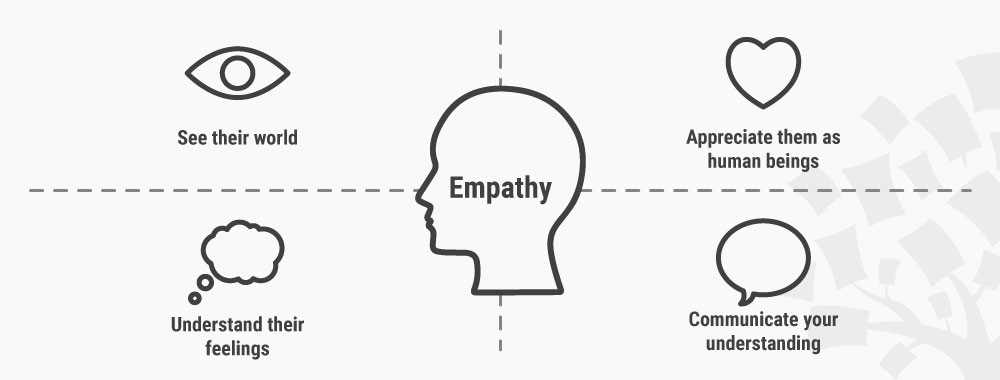
When we can notice our judgement and reactions firing up after any unwanted incident, behavior or mood within a work environment.. ASK. First.
What was a colleague's perception of an occurrence?
What was troubling about this occurrence?
What were the emotions that he/she felt at the time of the occurrence?
What emotions are being expressed in this moment?
What does he/she need from you (which is often just to be empathetic)?
Your ability to understand your own emotions will directly affect your ability to empathize with a colleague.
Allow yourself to be curious and open-minded
Allow yourself to listen as if your only job is to understand.
Allow yourself to listen without out using your preconceptions, allow yourself to know that you know nothing. Everything you need to learn you will be learning right now.
Free yourself from trying to create consistency between your feeling/perceptions and your colleagues feelings and perceptions…
For now just focus on understanding the unique experience of your colleague .
Act like a 'therapist'
Allow yourself to listen as if you are not personally responsible for the content.
Listen as though the narrative is not about you if you need help controlling your defensiveness or your guardedness.
Notice your bias and choose to not let it control your actions (see rules below).
Be vulnerable and accepting of your body’s natural response.
If your empathy encourages you to experience strong authentic emotions of your own (as opposed to emotions related to suppression, avoidance, denial or defensiveness) let them flow as long as they are not disruptive (anger) and hold an awareness of which emotions are yours and which emotions are your colleague.
Feeling the sadness of your colleague may make you upset…
Know that your time for expression will come… your ability to meet the emotional needs of your colleague will best prepare them to do the same for you.
Avoid Being ‘Right’
Avoid using your logic and reason to attempt to ‘disprove’ the validity of your colleagues emotional reaction or narrative.
Doing so can lead your colleague to feel belittled, patronized, powerless, insecure, misunderstood, oppressed, and attacked.
It does not matter that you believe that your colleague ‘mis-perceived’ the event, your colleagues emotional reactions are related to his/her perceptions (and not a ‘fixed’ or ‘true’ reality)
Be interested and empathetic to your colleagues experience as opposed to being fixated on making their perception the same as your perception.
Avoid being defensive.
Avoid correcting the plot line. Avoid using justifications. Avoid correcting what you view to be a ‘mis- perception’.
Avoid explaining why you did what you did.
Doing so can make your colleague feel frustrated, unheard, confused (by your somewhat irrelevant retort), and unimportant. The way that your colleague perceived the event is all that matters.
Allow yourself to notice your mind’s desire to correct the plot and then allow yourself to accept your colleagues subjective perception.
Avoid counter critiquing.
Avoid responding to your colleagues constructive criticism with your own criticisms about him/her.
Doing so can leave your colleague feeling annoyed, not listened to, invalidated, unimportant, frustrated, escalated, and desperate.
Often the narrative that you will need to listen to will be about you in some way… allow your colleague the space for expression… this is his/her time.
Avoid generalizations
Making over generalizations will lead to your colleague feeling hopeless and therefore more likely to ‘tune out’. Being very specific allows your colleague to better understand you.
Doing so can make your colleague feel, hopeless, attacked, defeated, as if you don’t want a solution, as if you are being too excessive to relate to, and irritated.
Example – you want to tell your colleague that you miss his/her company at friday evening work drinks, and you say, “ you never do anything fun anymore.”
Over generalizations tend NOT to have solutions and they can catastrophize which is isolating.
Avoid being contemptuous or trying to prove that your colleague is inherently flawed.
Avoid trying to attach permanent negative labels on your colleague.
In short being mean doesn’t help anyone and usually creates more guilt to manage later.
Doing so can make your colleague feel abused, defeated, hopeless, wounded, in danger, scared, angry and like giving up.
Avoid tuning out, or putting up a figurative wall.
Doing so can make your colleague feel, alone, isolated, unimportant, frustrated, desperate, and out of control.
Stay emotionally available… track the narrative and the emotions being displayed. to not literally or figuratively leave.
If you are overwhelmed please ask for a break and take some time to cool down (as it doesn’t help if you get overly emotionally escalated to the point of losing control). When you take a break tell your colleague what you are doing and when you will be able to return.
Avoid Creating a Guessing game.
Be clear with your needs and emotions…
Do not set your colleague up to fail by requiring them to guess what you are feeling or to guess what you need.
Doing so can make your colleague feel, inadequate, like a failure, incompetent, helpless, confused, guilty, and at a loss.
Always avoid saying one thing when your mean another… do not say “it is ok”, if it is “not ok”.
It is a huge misconception that “if your colleague values you they will intuitively know what you need and take action to meet your needs.” the truth is that we are often very poor at identifying and meeting our own needs…
This expectation will leave you frustrated without your needs being met.
If you want something… ask for it.
If you want your colleague to listen and to not fix it… tell them that.
With a greater understanding of empathy and communication, we can now learn a little more about some big issues and areas where empathy is needed.